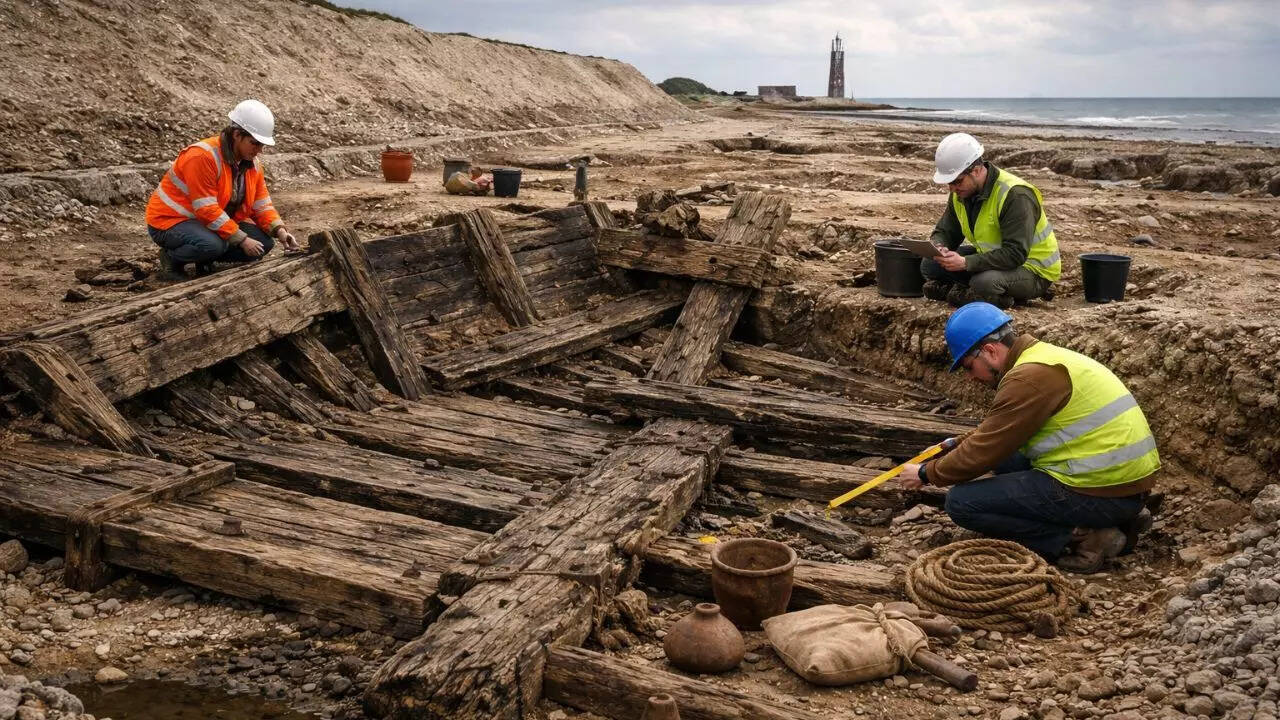
The water in the Solent is a murky, unforgiving gray. It doesn't invite you in; it warns you off. Five centuries ago, a man standing on the Southsea shoreline would have watched the pride of a king’s ambition—a massive, wooden beast of a ship—simply vanish beneath those waves. There was no cinematic explosion. There was only the sickening tilt of a hull, the frantic screams of seven hundred men, and then a silence that lasted for four hundred and thirty-seven years.
When the Mary Rose went down in 1545, she didn't just take Henry VIII’s favorite soldiers to the bottom. She took the medieval blueprint of England with her. What crawled out of the wreckage centuries later wasn't just a collection of Tudor artifacts. It was the DNA of an empire that hadn't even been born yet.
We often talk about naval power as a series of graphs and budget allocations. We look at the "Rise of the Royal Navy" as an inevitability. It wasn't. It was a desperate, messy response to a catastrophic failure.
The Weight of Wet Oak
To understand why a single shipwreck matters, you have to feel the weight of the era. Imagine you are a carpenter in the 1500s. You aren't building a boat; you are building a floating fortress. The Mary Rose was one of the first English ships to carry heavy guns low in the hull. This was high-stakes experimentation. Before this, sea battles were essentially land battles fought on platforms. You pulled up alongside your enemy, threw some hooks, and let the men with swords settle the score.
The Mary Rose changed the math. By cutting ports into the side of the ship to house massive bronze cannons, the English were trying to invent a new kind of violence. They wanted to kill from a distance.
But there is a price for innovation. On that July afternoon, as the French fleet loomed, the Mary Rose turned too sharply. The lower gun ports were open. The sea didn't ask for permission. It simply poured in. The ship didn't sink because of an enemy shot; it sank because it was too heavy with its own ambition.
The Men Who Never Came Home
We focus on the wood and the bronze, but the mud of the Solent preserved something far more haunting: the mundane.
When archaeologists finally began bringing the ship to the surface in 1982, they didn't just find cannons. They found nit combs. They found leather shoes worn thin at the heel. They found a tiny skeleton of a dog—the ship’s rat-catcher—trapped near the carpenter’s cabin.
These weren't "historical figures." They were teenagers from Devon who had never seen a map. They were professional longbowmen whose bones were permanently deformed from the sheer physical stress of pulling hundred-pound bows for a lifetime. Their skeletons tell a story of a society that was literally built for war. Their shoulders were broader on one side, their spines twisted into a permanent curve of readiness.
Consider the "Archer." We found his gear, his bracers, and his remains. He represents the end of an era. As the Mary Rose sat on the seabed, the longbow—the weapon that had defined English identity for centuries—was dying. The future belonged to the very cannons that had helped drag the ship down.
The Invisible Shift in the Wind
The loss of the Mary Rose was a national trauma, but it acted as a brutal teacher. Henry VIII realized that a navy couldn't just be a collection of converted merchant ships or experimental hulks. It had to be a professional machine.
The failure of the ship’s stability led to a revolution in naval architecture. The English stopped guessing. They started measuring. They began to treat the sea not as a barrier, but as a highway.
If the Mary Rose hadn't sunk, England might have remained a second-rate power, huddled on an island, terrified of the Spanish and the French. Instead, the catastrophe forced a professionalization of the Admiralty. It led to the creation of dockyards that would eventually churn out the vessels that defined the 18th and 19th centuries. The ghost of the Mary Rose haunts every victory at Trafalgar and every trade route established in the East.
It is a strange paradox of history: sometimes you have to lose your most prized possession to realize how to keep the rest of the world.
The Long Silence of the Mud
For over four hundred years, the ship lay on its side, half-buried. The silt of the Solent acted like a vacuum seal. It excluded oxygen, stopping the decay that usually turns shipwrecks into anonymous piles of timber.
When the divers first touched the wood in the 1960s, they weren't looking at a ruin. They were looking at a time capsule. Because the ship settled into the silt at a specific angle, the starboard side was perfectly preserved while the port side rotted away. It’s a literal cross-section of Tudor life. It’s a dollhouse of the Renaissance, sliced open for us to peer into.
Walking through the museum in Portsmouth today isn't like visiting a gallery. It’s like walking into a wake that has been held in suspension for half a millennium. You can smell the pitch. You can almost hear the creak of the timbers.
There is a specific kind of grief in seeing a bowl that still has the marks of a spoon in it, knowing the man who used it died in seconds. It strips away the "greatness" of history and replaces it with the terrifying reality of being human in a world that doesn't care if you live or die.
Why We Keep Diving
We are obsessed with the Mary Rose because she is a mirror. We look at the technical failures that sank her and see our own modern hubris. We look at the skeletons of the crew and see our own fragile bodies.
The ship didn't change England because it was a success. It changed England because it was a spectacular, public, and heartbreaking failure. It forced a king to look at the water and realize that if he wanted to own the horizon, he had to respect the physics of the waves first.
The English naval supremacy that followed wasn't built on gold or luck. It was built on the lessons learned from the men who stayed behind in the dark, cold mud of the Solent.
The water there is still gray. It is still cold. And somewhere, deep beneath the modern shipping lanes where massive container ships roar toward the horizon, the echoes of 1545 are still vibrating. We didn't just find a ship in 1982. We found the moment the world started to turn into the one we live in now.
The ocean has a long memory, but it doesn't give up its secrets for free. It keeps the bones, and it gives us back the truth.