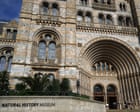
The Natural History Museum (NHM) in South Kensington has transitioned from a static repository of biological specimens into the primary engine of the UK’s visitor economy. In 2023, the institution recorded 5.7 million visits, a figure that represents not merely a recovery to pre-pandemic baselines, but a fundamental shift in how "free-to-access" cultural assets capture market share. This dominance is not an accident of geography or heritage; it is the result of a precise alignment between high-volume operational capacity, strategic intellectual property (IP) utilization, and the exploitation of the "Knowledge-Experience" gap in modern tourism.
The Architecture of Dominance
The NHM’s ascent to the top of the Association of Leading Visitor Attractions (ALVA) rankings is driven by three distinct structural pillars. These pillars convert raw footfall into institutional influence and sustainable operational models.
1. The Low-Barrier High-Utility Value Proposition
The NHM operates on a zero-price entry model for its permanent collections. In economic terms, this removes the immediate friction of the purchase decision, shifting the "cost" of the visit from financial capital to time capital. For families and international tourists—the two highest-value segments in the London market—the NHM offers a guaranteed utility. The "dinosaur" IP serves as a universal hook, transcending language barriers and age demographics, which allows the museum to maintain a high floor for daily attendance regardless of seasonal fluctuations.
2. Spatial Optimization and Flow Dynamics
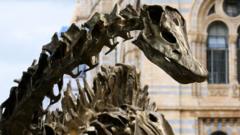
Unlike the British Museum, which struggles with a sprawling, multi-axial layout, the NHM utilizes a linear-progressive layout in its most popular galleries. Hintze Hall serves as a central hub (the "Grand Node") that distributes visitors into thematic zones. This spatial configuration allows for higher "carrying capacity"—the maximum number of visitors an environment can sustain without a degradation in the user experience. By managing flow through the "Whale as Anchor" strategy (replacing Dippy the Diplodocus with Hope the Blue Whale), the museum signaled a shift toward contemporary relevance and environmental urgency, which expanded its appeal to the climate-conscious Gen Z and Millennial demographics.
3. The Multi-Channel Revenue Engine
While entry is free, the NHM excels at "Secondary Spend Capture." The museum's physical layout forces a high percentage of visitors through gift shops and past high-margin food and beverage outlets. However, the true sophistication lies in its temporary exhibition strategy. By cordoning off specific, high-value content (such as Wildlife Photographer of the Year or Titanosaur) for paid ticketing, the museum segments its audience. It provides a mass-market experience for the general public while extracting premium value from "High-Intent" visitors.
Quantifying the "Specimen-to-Engagement" Ratio
To understand why the NHM outpaces the British Museum (5.5 million) and Tate Modern (4.7 million), one must analyze the density of its engagement. The NHM manages approximately 80 million items. The "Active Display Ratio"—the percentage of the collection visible to the public—is infinitesimally small. The museum's success stems from its ability to curate "Hero Specimens" that act as psychological anchors for the entire collection.
The Mechanism of Anchor Bias in Cultural Tourism
Visitors do not attend the NHM to see 80 million specimens; they attend to see five. This is a manifestation of the Pareto Principle in curation: 20% of the exhibits drive 80% of the visitor satisfaction.
- The Biological Scale: Large-scale skeletons provide an immediate "Awe Factor" that smaller, more complex art or historical artifacts struggle to replicate in a high-volume environment.
- The Narrative Arc: The NHM frames its collection within the "Crisis of the Anthropocene." This moves the museum from being a "Cabinet of Curiosities" to a "Solution Laboratory," making the visit feel socially and ethically productive for the visitor.
Operational Bottlenecks and the Risk of "Overtourism"
Despite the record-breaking 2023 figures, the NHM faces a diminishing marginal return on footfall. The physical infrastructure of a 19th-century Alfred Waterhouse building was not designed for a throughput of 5.7 million annual visitors.
The Heat and Humidity Variable
High visitor density increases ambient temperature and humidity levels within the galleries. This creates a "Micro-Climate Stress" on both the architecture and the specimens. The cost of climate control scales non-linearly with visitor numbers; a 10% increase in footfall can result in a 15-20% increase in HVAC energy consumption to maintain the strict environmental parameters required for preservation.
The Experience Decay Curve
As density increases, the "dwell time" (the amount of time a visitor spends looking at an exhibit) tends to decrease. In peak periods, the NHM risks becoming a "Transit Museum," where visitors move through spaces without engaging with the educational content. This creates a strategic risk: if the experience quality drops, the museum loses its "Recommendation Engine" (Word of Mouth), which is the primary driver of repeat domestic visits.
The Strategic Pivot: From Collection to Research Powerhouse
The public-facing museum is merely the "Marketing Department" for the NHM’s true asset: its scientific research division. The 5.7 million visitors provide the political and social capital necessary to secure government funding and private grants for its 350+ resident scientists.
The Digitization Frontier
The NHM is currently engaged in a massive digitization project. By converting physical specimens into digital assets, the museum is effectively decoupling its value from its physical location. This "Digital Twin" strategy allows for:
- Global Licensing: Selling high-resolution 3D data to film, gaming, and educational industries.
- Remote Research: Reducing the wear and tear on physical specimens by allowing global scientists to study them digitally.
- Expanded Reach: Engaging a global audience that will never step foot in London, thereby diversifying the museum's "Impact Portfolio."
The Competitive Landscape of the South Kensington Cluster
The NHM does not exist in a vacuum. It is part of the "Albertopolis" cluster, alongside the Science Museum and the Victoria and Albert (V&A) Museum. The NHM’s current lead in visitor numbers suggests a specific hierarchy of consumer preference in a post-inflationary environment.
- NHM vs. Science Museum: The NHM offers a more "Aesthetic-Organic" experience, which is more "Instagrammable" than the "Industrial-Technical" aesthetic of the Science Museum.
- NHM vs. V&A: The NHM has a lower "Intellectual Barrier to Entry." Understanding the significance of a dinosaur requires less cultural context than understanding the significance of 16th-century Italian ceramics.
This "Low Friction, High Visual Impact" combination is the winning formula in the attention economy. The NHM has successfully branded itself as the "entry-level" cultural experience for anyone visiting London, effectively capturing the widest possible funnel of the market.
Future Scaling: The Central Library and Research Zone (CRZ)
The next phase of the NHM’s evolution involves the physical expansion and relocation of significant parts of its collection to new facilities, such as the site at Harwell Science and Innovation Campus. This is a classic "Decoupling Strategy." By moving the research and storage functions away from the high-rent, high-traffic South Kensington site, the museum can:
- Increase Public Space: Convert back-of-house areas into new galleries, further increasing carrying capacity.
- Improve Preservation: Store delicate specimens in purpose-built, climate-controlled environments that are not subject to the vibrations and pollutants of Central London.
- Enhance Scientific Output: Provide researchers with modern laboratory space that the Waterhouse building cannot accommodate.
Strategic Action: The Optimization Playbook
For the NHM to maintain its status as the UK's top attraction while navigating the complexities of 2024-2026, it must execute the following maneuvers:
- Dynamic Flow Management: Implement AI-driven real-time heat mapping to redirect crowds away from congested areas like the Dinosaurs gallery toward under-utilized zones like the Darwin Centre. This levels out the Experience Decay Curve.
- Tiered Membership Personalization: Move beyond a flat membership fee. Introduce "After-Hours Access" or "Behind-the-Scenes Research" tiers to convert high-volume free visitors into high-value recurring donors.
- The "Sustainability Premium": Leverage its 2023-2024 "Planetary Emergency" messaging to partner with corporate sponsors looking for ESG (Environmental, Social, and Governance) alignment. This shifts the sponsorship model from "Logo Placement" to "Mission Integration."
- IP Monetization: Accelerate the licensing of its 3D-scanned collection to education-tech companies. As VR and AR become standard in global classrooms, the NHM should position itself as the primary content provider for biological and geological digital assets.
The Natural History Museum has proved that "Free" is a powerful pricing strategy, but its success is rooted in the "Premiumization" of the experience and the rigorous management of its physical and intellectual assets. Its future depends on its ability to remain a site of mass-market spectacle while functioning as a world-class laboratory for the future of the planet.