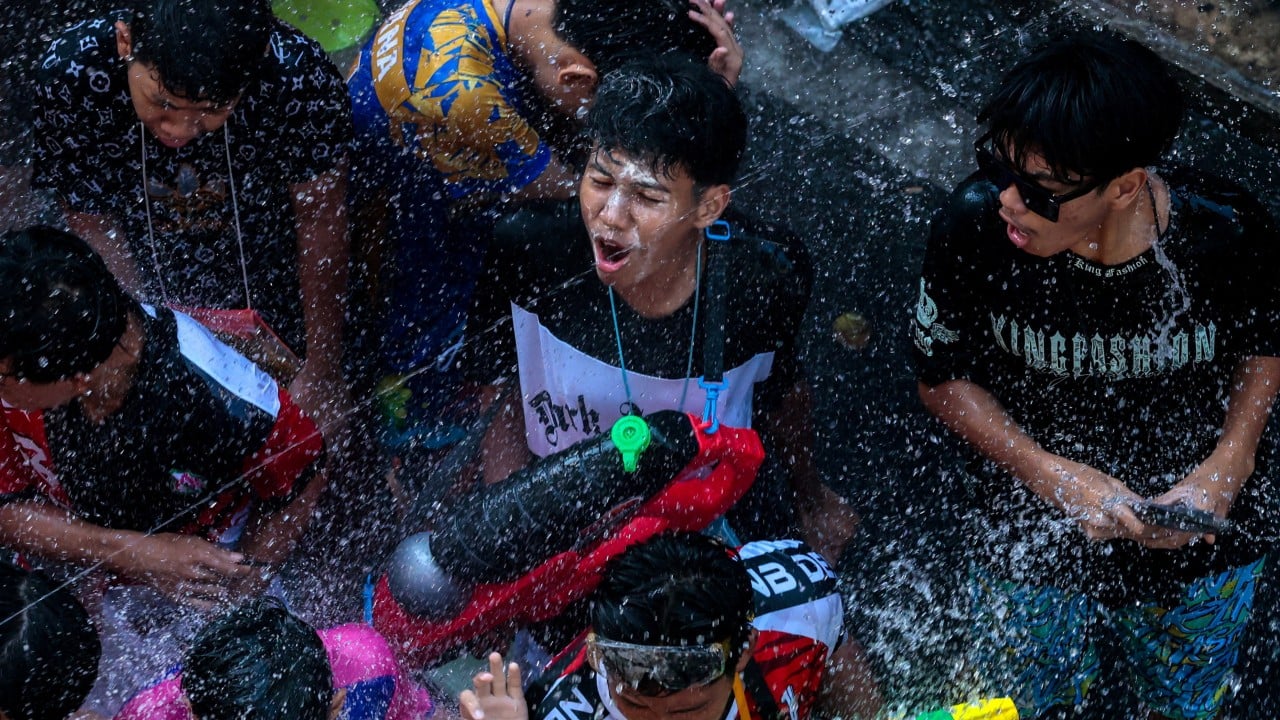
Anucha grips a plastic bucket until his knuckles turn white. Around him, the streets of Chiang Mai are a riot of wet pavement and neon-colored water pistols. The air smells of damp concrete, jasmine powder, and diesel exhaust. It is Songkran, the Thai New Year, a time when the entire nation dissolves into a collective, joyous soaking to wash away the misfortunes of the previous year. But as Anucha tips his bucket over a passing pickup truck, the splash feels heavier than usual. It feels like a debt.
While the tourists see a giant water fight, the people living behind the storefronts see a ledger that no longer balances. Thailand is currently caught between a traditional mandate to celebrate and a modern reality that is running out of breath. The country is parched. An El Niño cycle has squeezed the clouds dry, leaving reservoirs at ghost-town levels, yet the music blares and the water flows. It is a beautiful, desperate defiance. Meanwhile, you can find related events here: Operational Degasification and Tactical Erosion in the Lake Chad Basin.
The Spark and the Shortage
The irony of Songkran is that the more the sun beats down, the more water we use to hide from it. This year, the heat isn't just uncomfortable; it is predatory. Temperatures have routinely clawed past 40°C. In the cities, the air conditioners hum a low, menacing vibrato that signals a different kind of crisis.
Thailand’s power grid is screaming. To explore the complete picture, we recommend the detailed article by NBC News.
Most people don't think about natural gas when they are getting hit by a water balloon. They should. Thailand relies heavily on liquefied natural gas (LNG) to keep those air conditioners spinning and the lights of the festivals burning. But the global market for LNG is a shark tank. Prices have swung wildly due to geopolitical shifts in Europe and dwindling domestic production in the Gulf of Thailand. Every time a reveler steps into a chilled mall to escape the midday glare, they are tapping into a resource that is becoming prohibitively expensive.
Consider a hypothetical shop owner named Malee in Bangkok’s Sukhumvit district. For her, the festival is a double-edged sword. She needs the foot traffic that the "World Songkran Festival" brings, but her electricity bill has jumped by nearly 30 percent compared to last year. She watches the revelers spray high-pressure streams of water and calculates the cost of the pump, the cost of the ice, and the cost of the cooling.
The math is brutal.
A Thirst for Stability
The energy crisis isn't a vague ghost; it’s a structural fracture. Thailand has long been the "battery of Southeast Asia," but that battery is leaking. Domestic gas fields like Erawan have seen production dips, forcing the government to import more expensive fuel from abroad. When the global price of gas spikes, the "Fuel Adjustment Charge" on a grandmother’s utility bill in rural Isan spikes along with it.
It creates a strange, jarring contrast. On one hand, the government promotes Songkran as a "soft power" juggernaut to revitalize the tourism sector after the lean pandemic years. They want the crowds. They want the splashes. On the other hand, the Ministry of Energy is quietly asking citizens to turn off their lights and raise their thermostat settings.
It is hard to tell a nation to conserve when you have invited the world to a pool party.
The invisible stakes are found in the rice paddies outside the festival zones. Water diverted to keep the tourist hubs hydrated is water that isn't reaching the fields. Farmers watch the irrigation canals turn to cracked mud while the cities turn to slip-and-slides. This isn't just about a holiday; it’s about the hierarchy of need. Who gets to be wet when the country is dry?
The Rhythm of the Pump
We often treat energy as an infinite background noise. We flip a switch; the light comes on. We pull a trigger; the water fires. But energy is the literal current that carries the culture. If the LNG tankers don't arrive at the terminals in Rayong, the New Year falls silent.
The government has attempted to cushion the blow by subsidizing electricity prices and capping diesel costs, but subsidies are a sedative, not a cure. They mask the pain while the underlying infection—a heavy dependence on volatile fossil fuel imports—continues to spread. There is a growing movement toward solar and renewable energy, but the transition is moving at a snail's pace compared to the galloping demand of a country trying to cool itself down.
Anucha watches a group of teenagers refill their oversized water tanks from a communal tap. He wonders if they know where that water comes from. It’s pumped by electricity generated by gas piped from hundreds of miles away or shipped across oceans.
Everything is connected.
The splash of a bucket in Chiang Mai is the end of a very long, very expensive fuse. We are celebrating the New Year with the resources of the future, borrowing against a climate that is increasingly unwilling to lend.
The Cost of the Cool
If you walk through the night markets during the height of the festivities, the sensory overload is total. The scent of grilled pork mingles with the ozone of the electric displays. Massive LED screens show images of traditional dancers, their silk robes shimmering under lights that pull thousands of kilowatts from a strained grid.
It is a spectacle of resilience. Thais have always been masters of mai pen rai—the art of "it doesn't matter" or "don't worry about it." It is a cultural shock absorber that allows life to remain graceful even under immense pressure. But mai pen rai cannot fill a dry reservoir or lower the price of a metric ton of gas.
The vulnerability is becoming impossible to ignore. When the heat stays this high for this long, the body breaks, the machines break, and eventually, the economy breaks. We are seeing a shift in the way people talk about the festival. Older generations remember a Songkran that was a gentle sprinkling of water on the hands of elders—a symbolic cleansing. Today’s version is a high-velocity industrial event.
The transition from a ritual to an industry has changed the physics of the holiday.
Shadows in the Sun
There is a quiet fear that this might be the last year the "splash" can be this loud. Policy experts are looking at the data and seeing a collision course. If the droughts persist and the energy markets remain volatile, the "Land of Smiles" may have to choose between its most famous tradition and its basic industrial survival.
It’s a choice no one wants to make.
As the sun begins to set over the Doi Suthep mountain, the temperature finally drops to a point where the skin doesn't feel like it’s smoldering. The water on the streets starts to evaporate, leaving behind a white film of powder and the scent of exhausted celebration. The pumps start to slow down. The neon signs flicker, drawing their heavy toll from the transformers hummed to their limit.
Anucha drops his bucket. His arms ache. He looks at the puddles reflecting the dying light and thinks about the well at his family home in the countryside. Last week, his father told him the water level had dropped another meter. They had to buy a more powerful pump to reach it.
More power. More cost. More debt.
The party is far from over, but the music is starting to sound like a warning. We are a people dancing in the rain, even when the rain is something we had to buy on credit. The festival continues because it must, because the human spirit requires the release of the splash. But as the lights of the city burn bright against the darkening sky, one can't help but wonder what happens when the switch is flipped and nothing responds but the heat.
The water on the pavement dries quickly now. Within an hour, the dark patches of moisture vanish, leaving the concrete hot and thirsty once again.