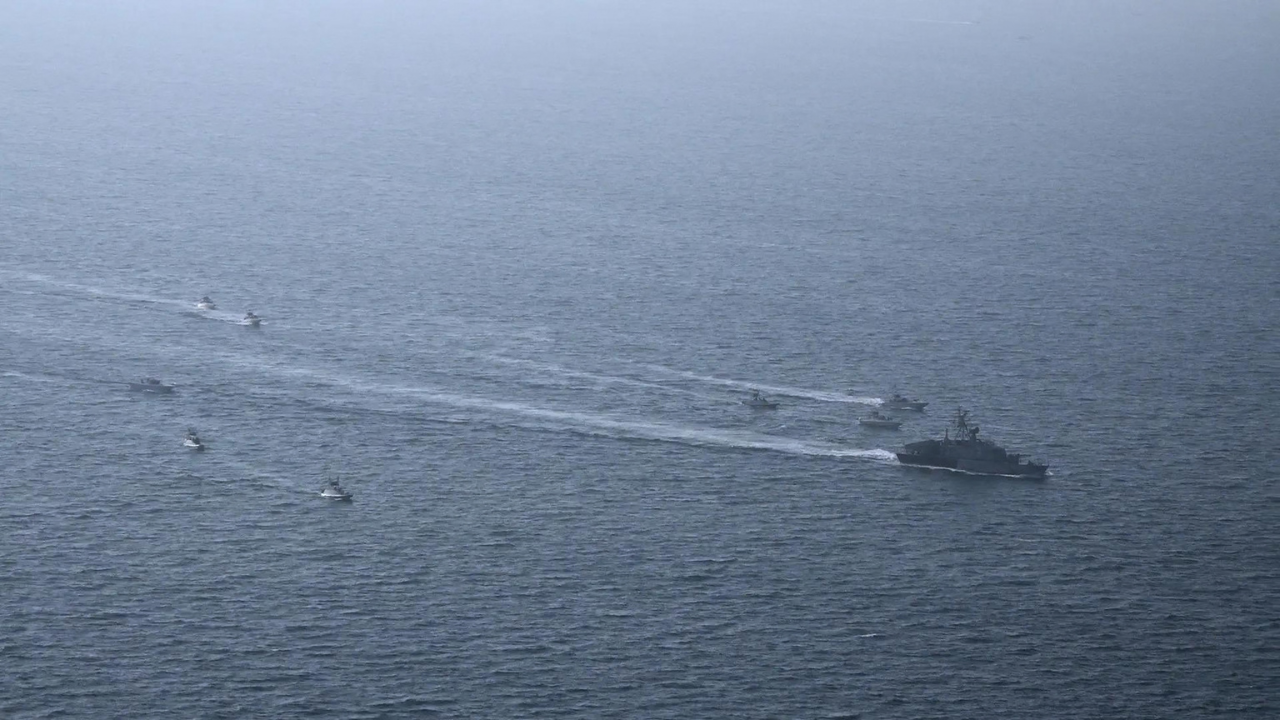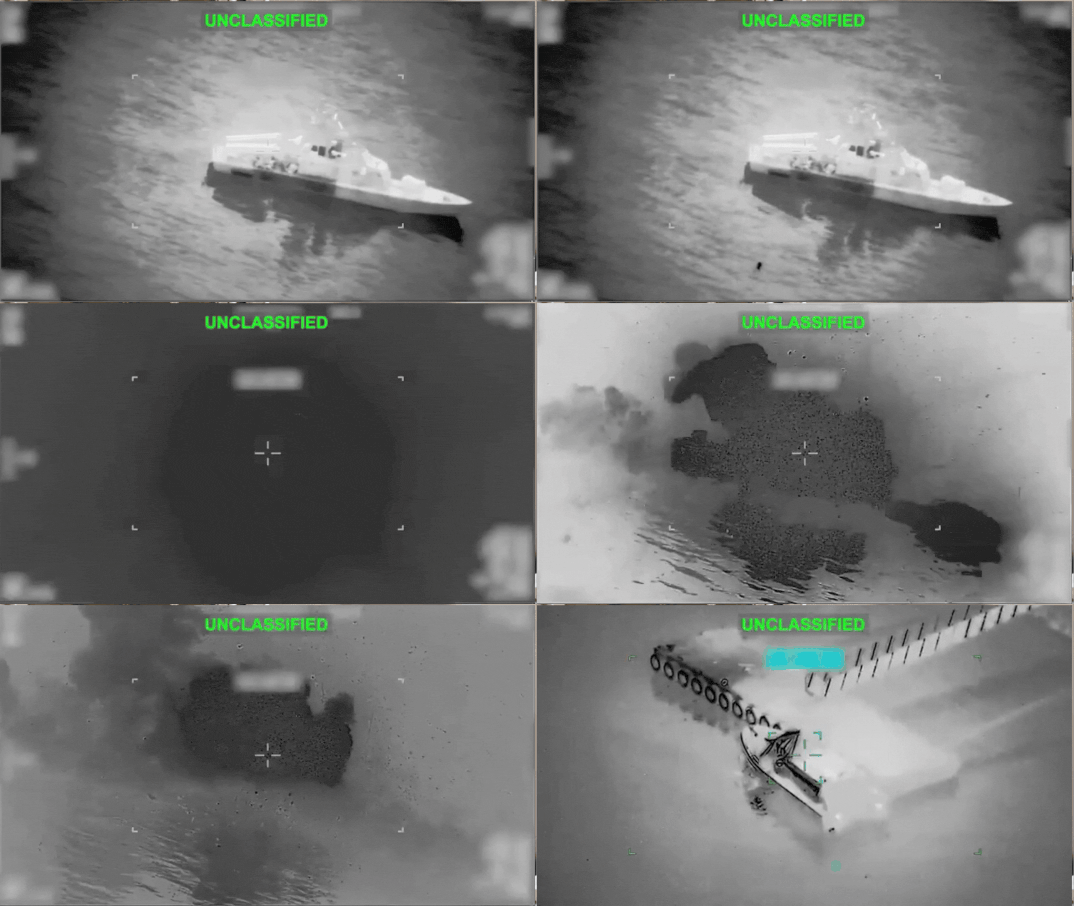
The footage is grainy, thermal, and predictable. A Hellfire missile tracks a small, cluttered deck in the Strait of Hormuz. There is a flash, a secondary explosion of ordnance meant for someone else’s hull, and then silence. The Pentagon press corps swoons. The headlines scream about "deterrence" and "decisive action."
They are wrong.
What you just watched wasn't a display of naval supremacy. It was an expensive, high-tech confirmation that the United States is currently losing the most important maritime evolution of the century. We are trading $150,000 missiles for $20,000 fiberglass boats, while the very presence of those minelayers proves that the Iranian "A2/AD" (Anti-Access/Area Denial) strategy is working exactly as intended.
By cheering for the destruction of a few Iranian minelayers, we are celebrating the fact that we have been forced to play a game where the house always loses.
The Mirage of Deterrence
The "lazy consensus" among defense analysts is that kinetic strikes in the Strait of Hormuz "send a message." The theory suggests that if you blow up enough Iranian assets, the Islamic Revolutionary Guard Corps (IRGC) will eventually decide the cost of harassment is too high.
This assumes the IRGC calculates value the same way a Lockheed Martin executive does. They don't.
In the world of asymmetric warfare, the "win" isn't keeping your boat afloat. The win is forcing a Carrier Strike Group—a multi-billion dollar asset—to burn fuel, stress its air wings, and reveal its electronic warfare signatures just to swat a fly. Every time a US destroyer has to engage a swarm of fast-attack craft or minelayers, the IRGC collects data. They learn our engagement ranges, our sensor limitations, and our ROE (Rules of Engagement) thresholds.
We are spending our capital. They are spending their "trash."
The Mathematics of Failure
Let’s talk about the "Cost Exchange Ratio." This is the metric that actually decides wars, though you’ll rarely hear it mentioned on cable news.
- The Iranian Asset: A localized, mass-produced fast-attack craft or a basic minelayer. Cost: Roughly the price of a mid-sized SUV.
- The US Response: An MH-60R Seahawk helicopter (Unit cost: $40 million) firing an AGM-114 Hellfire missile (Unit cost: $150,000).
When you factor in the hourly operating cost of the helicopter, the carrier it launched from, and the support fleet behind it, the US is spending millions to negate thousands. You cannot win a war of attrition when your opponent’s "ammunition" is cheaper than your "solution."
If Iran loses 100 minelayers, they have a bad Tuesday. If the US loses one Arleigh Burke-class destroyer to a $5,000 contact mine because we were too busy playing whack-a-mole with speedboats, the entire global insurance market for oil tankers collapses overnight.
The Mine is the Ultimate "Lazy" Weapon
The media focuses on the "watch the explosion" aspect because it’s visceral. It makes for good TV. But the real threat isn't the boat we just blew up; it's the six mines that boat dropped ten minutes before the drone arrived.
Sea mines are the "IEDs of the ocean." They are passive, persistent, and terrifyingly effective.
- Contact Mines: The old-school spiked spheres. Cheap, effective, and require physical touch.
- Influence Mines: These listen for the specific acoustic signature of a hull or sense the magnetic distortion caused by a massive steel ship.
- Moored vs. Bottom Mines: Some float just below the surface; others sit on the seafloor in shallow bottlenecks like the Strait of Hormuz, waiting for a pressure change.
The Strait of Hormuz is only 21 miles wide at its narrowest point. The actual shipping lanes are even tighter—barely two miles wide in each direction. You don't need a "Navy" to close the Strait. You need a dozen guys with bad intentions and a few crates of Soviet-era leftovers.
When the US "destroys" a minelayer, we are reacting to a symptom. The "disease" is the fact that the Strait is the most vulnerable choke point on the planet, and our current naval doctrine is built for mid-ocean battles that will never happen.
The Technology Trap
We are obsessed with "exquisite" technology. We want the most advanced radars, the stealthiest hulls, and the most integrated battle management systems. But in the shallow, cluttered waters of the Persian Gulf, high-tech is often a liability.
Radar struggles with "clutter"—the thousands of dhows, fishing boats, and commercial vessels that fill the Strait. A fiberglass minelayer has a radar cross-section roughly the size of a large seagull. By the time a sophisticated Aegis system discriminates that boat from a wave crest, the mines are already in the water.
Furthermore, we are overly reliant on GPS and satellite links. I’ve spoken with electronic warfare officers who have seen "blackout zones" where regional jamming becomes so intense that our billion-dollar platforms are essentially flying or sailing blind for minutes at a time. Iran knows this. They don't need to out-tech us; they just need to "dirty up" the environment enough that our tech becomes an expensive paperweight.
The Logistics of a Locked Gate
People ask: "Can't the US Navy just sweep the mines?"
Yes. Eventually.
But "eventually" is a word that triggers a global economic depression. The US Navy’s mine countermeasures (MCM) capabilities have been the neglected stepchild of the fleet for decades. We retired the Avenger-class ships and tried to replace their functionality with the Littoral Combat Ship (LCS) "mission packages" which, to put it mildly, have been a developmental nightmare.
If Iran successfully sows a minefield in the shipping lanes:
- Global oil prices spike 30% in two hours.
- Shipping insurance (P&I clubs) cancels coverage for any vessel entering the Gulf.
- The world’s "just-in-time" supply chain begins to fracture.
Clearing a minefield isn't like mowing a lawn. It’s like looking for a needle in a haystack, where the needles can blow your head off and the haystack is the size of a city. It is slow, methodical, and dangerous work. While we are "sweeping," the global economy is bleeding.
The Counter-Intuitive Truth
If we actually wanted to secure the Strait, we would stop filming "cool" explosions and start acknowledging that the traditional Carrier Strike Group is the wrong tool for this job.
We are using a sledgehammer to perform surgery.
The obsession with "destroying" Iranian assets is a PR move designed to satisfy a domestic audience that wants to see "strength." True strength in the Strait would look like a massive, unglamorous investment in autonomous underwater vehicles (AUVs) and disposable sensor networks that make minelaying impossible to do covertly.
Instead, we stay in this cycle:
- Iran provokes.
- The US destroys a low-value target.
- The Pentagon releases a video.
- The public feels safe.
- The underlying vulnerability remains untouched.
Stop Asking if We Can Win
The question isn't whether the US Navy can "win" a confrontation with the Iranian Navy. Of course we can. We could turn their entire coastal infrastructure into a parking lot in 72 hours.
The real question is: Can we maintain the flow of commerce through a 21-mile wide gap while an adversary uses $500 drones and $2,000 mines to stop us?
Currently, the answer is no.
Every time we celebrate the "destruction" of a minelayer, we are admitting that the minelayer got close enough to be a threat in the first place. We are celebrating our own reactive posture. We are playing their game, on their turf, by their rules.
The grainy video of the exploding boat isn't a victory. It’s a warning. We are one lucky Iranian mine away from realizing that our naval "paradigm" is a paper tiger in the shallows.
Take the "win" if it makes you feel better. But remember that while we were watching the explosion, the water is still getting deeper, and the mines are still sinking.
Order the fleet to stop chasing headlines and start solving the math of the bottleneck before the gate slams shut for good.