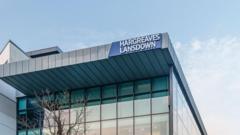
The outrage cycle is as predictable as a Swiss watch. A major platform like Hargreaves Lansdown suffers a technical glitch, the "Unable to Transact" banners go up, and suddenly every armchair investor on X is screaming about incompetence, lost opportunities, and the end of financial stability. They call it a "catastrophic failure." They demand heads on pikes. They claim they lost thousands because they couldn't sell a mid-cap tech stock during a three-hour window.
They are almost entirely wrong. For an alternative perspective, check out: this related article.
The lazy consensus among financial journalists is that 100% uptime is the only acceptable metric for a modern brokerage. It makes for a great headline, but it betrays a fundamental misunderstanding of how wealth is actually built and how systems actually fail. If you think a four-hour outage at a retail broker is a threat to your financial future, the problem isn't the software. The problem is your strategy.
The Myth of the Critical Moment
Most retail investors suffer from the "Main Character Syndrome" of finance. They believe that their specific trade, at 10:15 AM on a Tuesday, is the hinge upon which their retirement swings. It isn't. Unless you are running a high-frequency trading desk out of your basement—which, let's be honest, you aren't—the "cost" of an outage is usually psychological, not financial. Related reporting regarding this has been published by Business Insider.
When a platform like HL goes down, the media focuses on the "missed" trades. But they never talk about the "saved" trades.
Imagine a scenario where a sudden market dip triggers a panic. Thousands of retail investors rush to the "Sell" button, driven by cortisol rather than logic. If the platform freezes, those investors are forced to sit on their hands. By the time the systems are back up, the dip has often retraced, or the panic has cooled. For a significant portion of the user base, an IT failure acts as an unintentional "circuit breaker" that prevents them from committing the cardinal sin of investing: selling low during a volatility spike.
Why 100% Uptime is a Dangerous Fantasy
In the world of enterprise architecture, there is a concept called "The Fallacy of the Five Nines." Companies strive for 99.999% uptime. Achieving that last 0.009% costs exponentially more than the first 99%.
I have seen firms dump tens of millions into redundant systems, "active-active" data centers, and "chaos engineering" protocols, only to have the whole thing brought down by a single corrupted BGP update or a typo in a configuration file. Complexity is the enemy of security.
When you demand absolute, unwavering access, you are demanding a level of system complexity that actually increases the risk of a "black swan" failure. A simpler system that breaks occasionally but predictably is often safer than a hyper-complex "bulletproof" system that fails in ways nobody can understand or fix quickly.
Hargreaves Lansdown manages over £150 billion in assets. Their primary job isn't to make sure you can day-trade a meme stock during your lunch break; it's to ensure the underlying ledger—the record of who owns what—remains immutable and accurate. If a trade gateway fails, it’s annoying. If the database that says you own 500 shares of Shell becomes corrupted because they were rushing a "seamless" update to satisfy the 100% uptime mob, that is a terminal event.
The Institutional Double Standard
Why is it that when the London Stock Exchange (LSE) has a technical delay, it's treated as a "market event," but when a retail broker has one, it's "shambolic"?
Institutions understand that friction is part of the machine. They build their strategies around the reality that liquidity is not a constant. Retail investors, pampered by the "gamification" of finance, have been conditioned to believe that the market is a vending machine. Press button, get stock. Immediately.
The truth is that the "instant" nature of modern retail investing is an illusion. Your order goes through a series of intermediaries, market makers, and clearing houses. There are dozens of points of failure. When you complain about a web interface being down, you are complaining about the paint job on a car while ignoring the engine.
Stop Asking the Wrong Questions
The "People Also Ask" section of any search engine during a broker outage is a graveyard of bad priorities:
- "How do I claim compensation for a broker outage?"
- "Which broker has the best uptime?"
- "Can I sue for lost profits?"
These questions focus on the wrong side of the ledger. If you want to be a resilient investor, you should be asking:
- "Does my portfolio rely on minute-by-minute liquidity?" If the answer is yes, you are a gambler, not an investor.
- "Is my broker's balance sheet strong enough to survive a systemic shock?" This matters infinitely more than whether their app crashed this morning.
- "Do I have a secondary way to exit a position?" Most brokers have telephone trading desks. Yes, the wait times are long during an outage. That’s the price of a crisis.
The Brutal Advice You Won't Like
If you are genuinely concerned about platform outages, the solution isn't to find the "perfect" broker. They don't exist. The solution is redundancy and laziness.
- Split the Stash: Never keep 100% of your liquid assets in one wrapper. If you have a large ISA, keep a secondary trading account with a different provider that uses a different backend. If HL is down, maybe AJ Bell or Interactive Brokers is up.
- Extend Your Horizon: If your investment thesis can be ruined by a four-hour delay, your thesis was garbage. Real wealth is built over decades. A morning of "internal server errors" is a rounding error in a thirty-year compound interest calculation.
- Appreciate the Friction: Use the downtime to ask yourself why you were trying to trade in the first place. Was it a planned move? Or were you just reacting to a notification on your phone?
The "IT failure" at Hargreaves Lansdown isn't a sign of a dying giant or a broken industry. It is a reminder of the physical reality of the digital world. Bits flip. Servers overheat. Code breaks.
The most successful investors I know didn't get rich because they had the fastest app or the most "robust" connection. They got rich because they bought quality assets and then forgot their login passwords for five years.
Stop checking the price. Stop demanding the impossible. And for heaven's sake, stop acting like the world is ending because a website went down. If you can’t handle a few hours of downtime, you aren't ready for the volatility that actually makes you money.
Stop treating your brokerage like a video game. It’s a vault. Sometimes the door gets stuck. As long as the gold is still inside when it opens, you’re fine.