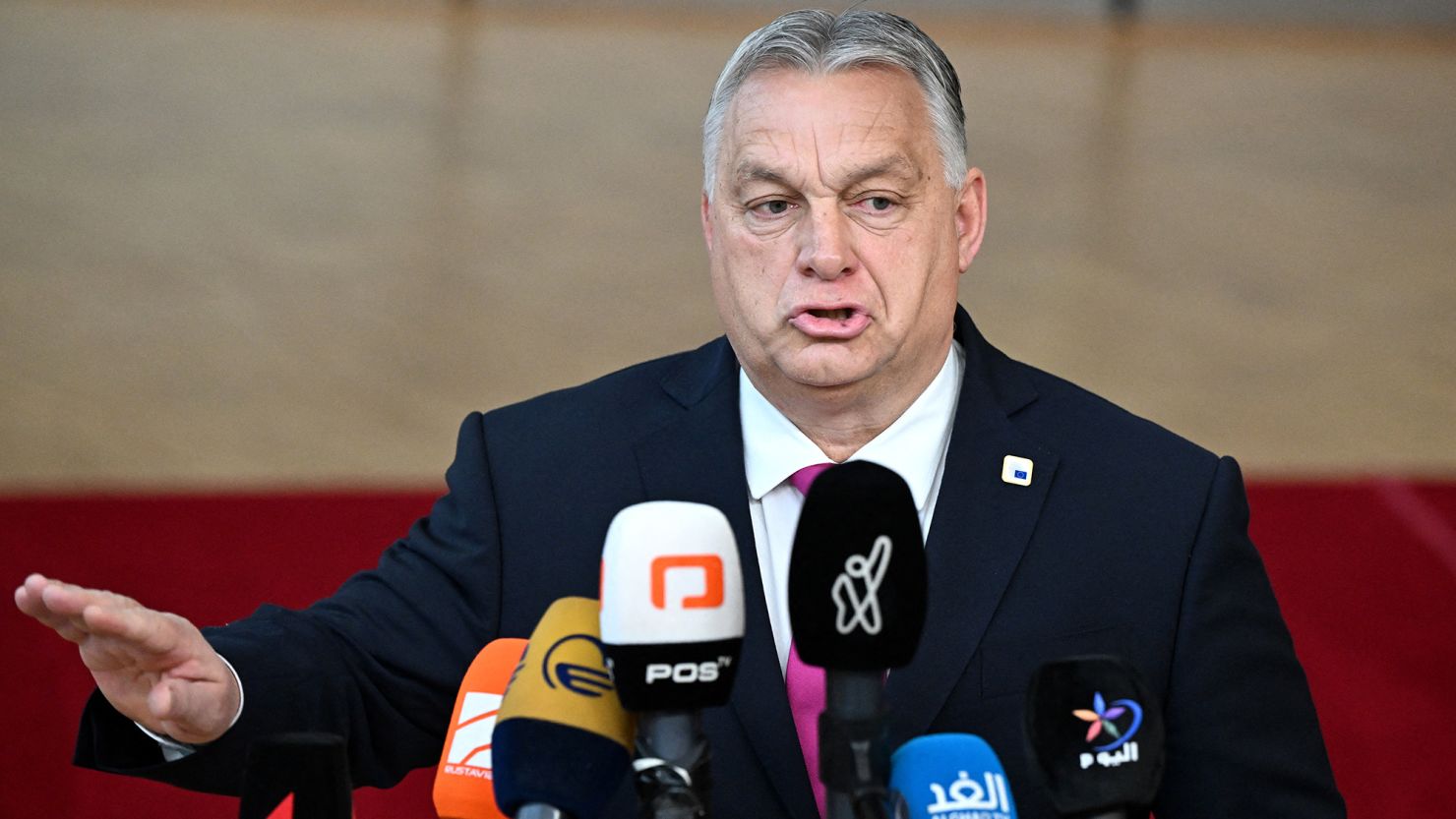
Brussels is screaming. The headlines call it "sabotage." European leaders are lining up to cast Viktor Orban as the villain in a low-budget political thriller, accusing him of holding the continent hostage over the latest Ukraine aid package.
They are wrong. They are lazily repeating a narrative that ignores the cold, mathematical reality of the Eurozone. Orban isn't the problem. He is the only person in the room pointing at the structural rot that everyone else is trying to paper over with printed money and moral grandstanding.
The consensus view suggests that if Orban would just get out of the way, the EU could "save" Ukraine and solidify its own geopolitical standing. This is a fantasy. In reality, the 50-billion-euro package isn't a strategy; it’s a high-interest payday loan taken out against a future the EU cannot afford.
The Sovereignty Myth and the Rule of Law Trap
Mainstream reporting focuses on the "Rule of Law" mechanism—the idea that the EU is withholding funds from Hungary because of democratic backsliding. This is a convenient smokescreen. If the EU actually cared about the rigid application of its own rules, it would have dealt with the fiscal non-compliance of its powerhouse members years ago.
Instead, "Rule of Law" has become a financial cudgel. It’s used to enforce political orthodoxy. When Orban blocks a budget, he isn't just "pro-Russian" or "obstructionist." He is exposing the fact that the EU’s financial architecture is now entirely dependent on coerced unanimity.
I’ve watched bureaucrats in Brussels burn through billions on "integration" projects that have zero ROI. The Ukraine aid package is the ultimate version of this. It is a massive transfer of wealth from European taxpayers into a conflict with no defined exit strategy and no audit trail. By using his veto, Orban is forcing a conversation about the opportunity cost of this capital—a conversation the European Commission is terrified to have.
The Mathematical Impossibility of Endless Aid
Let’s look at the numbers the "slamming" leaders won't mention. The EU is already grappling with a stagnant economy, skyrocketing energy costs, and a demographic collapse that makes its pension systems look like a giant Ponzi scheme.
Adding 50 billion euros to the ledger isn't just a drop in the bucket. It is a commitment to a long-term subsidy model. Ukraine’s reconstruction costs are estimated by the World Bank to be well over $411 billion. The 50 billion currently on the table is a down payment on a debt that will never be repaid.
When Orban demands that aid be reviewed annually rather than being a four-year blank check, he is practicing basic fiduciary responsibility. In any private equity firm, a partner demanding an annual review of a high-risk, non-performing asset would be called "diligent." In Brussels, he’s called a "traitor."
- The Inflationary Pressure: Printing or borrowing 50 billion euros doesn't happen in a vacuum. It devalues the currency every citizen from Lisbon to Berlin uses to buy bread.
- The Debt Trap: This aid is largely funded through joint debt. This is "Hamiltonian integration" by the back door—forcing member states into a fiscal union they never explicitly voted for.
The Brussels Echo Chamber
The anger directed at Budapest is born from fear. Leaders like Macron and Scholz are facing plummeting approval ratings and rising domestic opposition. They need a bogeyman. They need Orban to be the reason things aren't working, because the alternative—admitting that the EU's central planning is failing—is unthinkable.
They claim Orban is "isolated." Look at the actual political shifts across the continent. From the Netherlands to Italy to Slovakia, the "Orban style" of national-interest-first politics is winning. The "isolated" one is actually the Brussels establishment, which continues to operate as if it's 2005 and the era of endless growth is still here.
Imagine a scenario where the veto didn't exist. The EU would have already committed hundreds of billions more with zero debate. The veto is the only emergency brake left on a train headed for a fiscal cliff.
The Accountability Gap
The "People Also Ask" sections of the internet want to know: "Why does Hungary get to stop the whole EU?"
The answer is: because that’s the contract they all signed. The EU is a union of sovereign states, not a federal empire. When leaders "slam" Orban for using his legal right, they are essentially saying the rules only matter when they produce the "correct" outcome.
If you want to talk about "democracy," start with the fact that Orban has a massive domestic mandate to do exactly what he is doing. His voters don't want their tax money sent to a non-member state while their own borders are under pressure and their energy bills are tripling.
The Real Danger of the 50 Billion Euro Package
The most dangerous part of this aid package isn't the money itself. It’s the precedent of automaticity.
Brussels wants to move toward a system where funding for foreign conflicts and massive social engineering projects is "automatic" and "uninterruptible." This is the death of politics. If the people through their national representatives cannot stop the flow of their own money, they are no longer citizens; they are subjects.
Orban is effectively demanding a "Receipts and Results" policy. He is asking:
- What is the specific milestone for this funding?
- What happens if the funds are diverted?
- Why is this being funded through common debt rather than national contributions?
These are not the questions of a "pro-Putin" puppet. These are the questions of a man who knows that when the music stops, the smaller nations will be the ones left without a chair.
Stop Calling it a "Blockade" and Start Calling it an "Audit"
The media calls it a blockade. It’s actually a demand for an audit. The EU is attempting to bypass its own budgetary constraints by creating "off-budget" vehicles to fund Ukraine. This is accounting trickery that would get a CEO landed in federal prison.
By standing in the way, Hungary is forcing the EU to admit that its current budget is a fiction. The "slamming" we see in the press is the sound of panicked politicians who don't want to explain to their own voters why they are prioritizing the borders of a non-member over the economic stability of their own.
The contrarian truth is that the EU needs more "Orbans," not fewer. It needs more leaders willing to be hated by the press in exchange for protecting the long-term solvency of their nations.
If the EU cannot survive a single member state asking for a yearly review of a 50-billion-euro gift, then the EU is already dead. It is a fragile, top-heavy bureaucracy that can't handle the slightest breeze of dissent.
Orban isn't killing European unity. He’s the only one proving it’s already gone, replaced by a desperate, debt-fueled conformity.
Europe doesn't have an "Orban problem." It has a reality problem. And reality always wins.
Stop looking at the veto as a bug. It is the only feature left that prevents the total erasure of national agency in favor of a bankrupt central authority. The "villain" in Budapest is simply the only one brave enough to tell the emperor he isn't wearing any clothes—and that the clothes were bought on a credit card the citizens will be paying off for the next three generations.