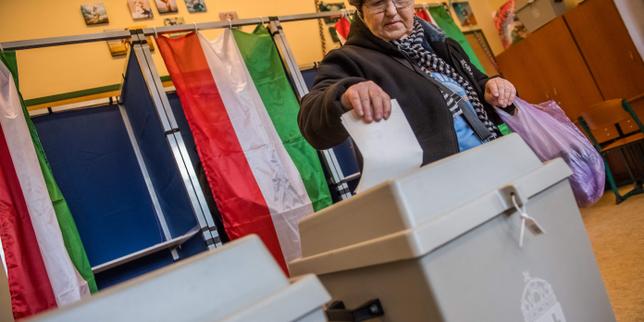
Viktor Orban remains the central gravity point of Hungarian politics, but the massive surge in voter participation has fundamentally altered the math of his survival. While early tallies suggest the Fidesz machine held its ground in rural strongholds, the sheer volume of ballots cast—reaching levels not seen since the fall of communism—indicates a mobilization that transcends simple party loyalty. This is no longer a standard election cycle. It is a national stress test for a system built on total media dominance and a fractured opposition that finally found a reason to consolidate.
The Rural Fortress and the Urban Surge
The narrative that Hungary is a country divided between Budapest and "the rest" is an oversimplification that misses the mechanical reality of how Orban maintains power. Fidesz has spent over a decade perfecting a patronage network that makes the state and the party indistinguishable in smaller municipalities. In these regions, a vote for the status quo is often a vote for economic stability, or at least the avoidance of the perceived chaos promised by state-controlled media.
However, the record turnout suggests that the "apathy gap" has closed. Historically, high turnout in Central Europe favors the challenger, as it implies that the "silent middle"—those who usually stay home out of cynicism—felt compelled to act. The opposition, under the United for Hungary banner, bet everything on the idea that Orban could be beaten if they stopped fighting each other and focused on a single point of failure: the erosion of democratic checks.
The Logistics of Influence
To understand how Fidesz operates, one must look at the public works programs. These are not merely social safety nets; they are levers of influence. In hundreds of villages, the local mayor, almost always a Fidesz loyalist, controls the distribution of these jobs. When a voter enters the booth in a village of 500 people, the pressure is not necessarily from a police presence, but from the quiet understanding of where their next paycheck originates.
The Peter Marki-Zay Factor
The emergence of Peter Marki-Zay as the opposition leader was an attempt to short-circuit the Orban playbook. By running a conservative, practicing Christian from the provinces, the opposition hoped to neutralize the "Brussels-loving liberal" label that Fidesz applies to any dissenter. It was a calculated risk. Marki-Zay spoke a language that rural voters understood, focusing on corruption rather than abstract ideological debates.
But the machine responded with a blitzkrieg of negative advertising. In the weeks leading up to the vote, the Hungarian landscape was blanketed with posters painting the opposition as puppets of foreign interests or, more effectively, as warmongers who would drag Hungary into the Ukrainian conflict. This "peace vs. war" narrative became the definitive wedge issue. Orban positioned himself as the only guarantor of Hungarian neutrality, a move that resonated deeply with a population weary of being caught between Great Power interests.
Media Monopoly as a Hard Ceiling
The most significant hurdle for any challenger in Hungary is not the ballot box, but the information environment. Nearly 90% of all media in the country is owned either by the state or by businessmen with direct ties to the Prime Minister. During this election, the opposition was granted a total of five minutes of airtime on public television over the entire campaign period.
This isn't just a disadvantage; it is a structural barrier. When the record turnout numbers began to flash across the screens in Budapest, the immediate question was whether the opposition’s grassroots social media campaign could compete with the 24/7 saturation of the Fidesz message on every radio station and local newspaper.
Financial Asymmetry
The spending gap is equally staggering. Fidesz and its associated NGOs outspent the entire opposition coalition by an estimated factor of ten. This money didn't just go to TV spots. It went to a sophisticated data-mining operation that allowed the party to target "swing" voters with personalized messaging about utility price caps and pension bonuses. In the final days of the campaign, the government issued a massive tax rebate to families and a 13th-month pension. These were not hidden bribes; they were the centerpiece of a campaign that treated the national budget as a campaign fund.
The European Union Dilemma
Brussels has watched this election with a mixture of dread and paralysis. A definitive Orban victory validates his "illiberal democracy" model, providing a blueprint for other populist movements across the continent. A loss, or even a significantly narrowed majority, would embolden the European Commission to trigger the "rule of law" mechanism, which could freeze billions in funding.
The tension lies in the fact that the Hungarian economy is deeply integrated with German industry. While politicians in Brussels talk about sanctions, car manufacturers in Stuttgart rely on Hungarian factories. Orban knows this. He has played a double game for years: railing against European "interference" while ensuring that the wheels of industry keep turning.
Reconstructing the Voting Map
As the counting continues, the focus remains on the "winner-takes-all" individual constituencies. In 2018, Fidesz won a two-thirds majority despite receiving less than 50% of the popular vote, thanks to a gerrymandered map and a fragmented opposition. This time, the map is the same, but the fragmentation is gone.
If the opposition fails to flip the rural districts despite the massive turnout, it proves that the Fidesz grip on the provincial psyche is absolute. It would suggest that no amount of unity or "outsider" appeal can overcome the combined weight of state media and economic patronage.
The high participation rate proves one thing: the Hungarian public is not indifferent. They are deeply, perhaps irrevocably, polarized. This wasn't just an election for a parliament; it was a referendum on the very soul of the nation. Whether the result yields a mandate for more centralization or a shock to the system, the old ways of governing Hungary are being pushed to their breaking point.
The Strategy of the Final Hour
In the closing hours of voting, reports surfaced of organized transport for voters in key battleground districts. This is a common tactic, but the scale observed this time was unprecedented. In some border regions, ethnic Hungarians with dual citizenship were brought in by the busload. While legal under the current framework, these maneuvers highlight the "grey zone" tactics that Orban has codified into law.
The opposition’s strategy relied on a massive surge in Budapest to offset the rural losses. They needed a landslide in the capital to have any hope of a majority. The early data shows they got the surge, but the rural turnout was equally aggressive. This suggests that the Fidesz base was not demoralized by the opposition’s unity; they were galvanized by it. They saw the "all-in" approach of the six-party coalition as an existential threat to the world Orban built for them.
The immediate fallout will be felt in the markets. The Forint has been volatile, reflecting the uncertainty of what a contested result or a continued Orban dominance means for foreign investment. If Orban secures another supermajority, the path toward a complete "state-capture" model becomes irreversible. The judiciary, the universities, and the remaining independent media outlets will be the next targets for "nationalization."
The Myth of the Neutral Observer
The presence of an unprecedented number of international election observers from the OSCE signifies the level of global concern. Their preliminary reports are expected to focus not on the day of the vote, but on the "uneven playing field" of the months preceding it. However, internal Hungarian politics has become increasingly immune to external criticism. Orban has successfully framed any foreign critique as an attack on Hungarian sovereignty.
This mindset is the real victory for Fidesz. They have successfully shifted the debate from "Is this policy good for the country?" to "Who is a 'true' Hungarian?" When an election is fought on the terrain of identity rather than policy, turnout becomes a weapon.
The final tally will do more than just seat 199 MPs. It will determine if the Orban model is a localized anomaly or a repeatable strategy for holding power in the 21st century. The high turnout isn't a sign of a healthy democracy; it is a sign of a society in a state of total mobilization, where the stakes are perceived as nothing less than the survival of the nation itself.
The counting of the mail-in ballots from the diaspora will likely drag into the night, but the trend lines are clear. The machine is being tested by a volume of opposition it has never faced, yet its foundations—built on the control of information and the distribution of state resources—remain remarkably resilient. The era of easy victories is over, but the era of Orban is far from finished. It has merely entered a more aggressive, more defensive phase.