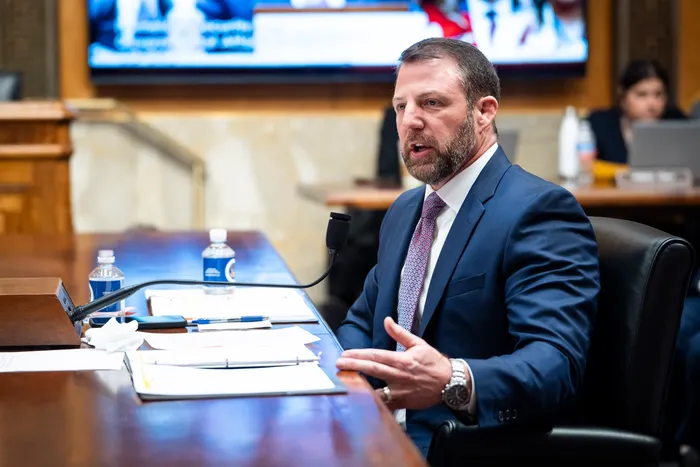
The Senate Homeland Security and Governmental Affairs Committee has cleared the path for Senator Markwayne Mullin to transition from a seat on the panel to the head of the Department of Homeland Security (DHS). This move is not merely a personnel change. It represents a fundamental pivot in how the United States intends to manage its borders, its cyber defenses, and its massive federal law enforcement apparatus. While the public focus remains fixed on the political optics of a sitting Senator jumping to the Cabinet, the real story lies in the specific, aggressive mandate Mullin carries into a department that has long struggled with identity and mission creep.
Mullin’s nomination moved through the committee with a level of velocity that suggests the executive branch is finished with the era of cautious, career-bureaucrat leadership. The DHS is the third-largest Cabinet department, born out of the ashes of 9/11 with a mandate to prevent terrorism. Yet, under the proposed Mullin tenure, the department's "homeland" definition is expanding. We are looking at a shift toward a more militarized border posture and a transactional approach to international security partnerships.
The Enforcement First Mandate
The primary driver behind this nomination is the exhaustion of the status quo at the southern border. For decades, DHS leadership has attempted to balance humanitarian processing with enforcement. Mullin’s testimony and track record indicate that this balance is being discarded in favor of a singular focus on deterrence. This isn't just about wall construction; it is about the deployment of high-altitude surveillance and the reclassification of cartels as foreign terrorist organizations.
If the DHS successfully reclassifies these criminal syndicates, the legal toolkit available to Mullin changes overnight. This allows for the freezing of assets and the use of extraterritorial authorities that were previously reserved for groups like Al-Qaeda. It moves the border fight from the scrublands of Texas into the global financial system. However, this strategy carries the risk of diplomatic ruptures with Mexico, a partner that has historically bristled at American "interventionism" labeled as law enforcement.
Intelligence Integration and the End of Silos
One of the most persistent criticisms of the DHS since its inception in 2002 has been its inability to make its various sub-agencies—ICE, CBP, the Coast Guard, and CISA—actually talk to one another. The "stovepipe" problem is a classic bureaucratic failure. Mullin, coming from a background in private business and wrestling, tends to view organizational friction as a personal affront. His supporters believe he will use his political capital to force a data-sharing environment that has eluded his predecessors.
The integration of biometric data across these agencies is the technical backbone of this plan. By centralizing the "Identity Intelligence" (I2) framework, the department aims to create a continuous vetting system for anyone entering the country. This means a person's digital footprint, financial history, and biometric markers would be accessible to a CBP officer in real-time. The efficiency gains are obvious. The privacy implications, however, remain a darkened corner of the conversation that the Senate panel largely avoided during the hearings.
The Cyber Frontier and CISA Under Fire
While border security grabs the headlines, the Cybersecurity and Infrastructure Security Agency (CISA) sits as the most delicate piece of the DHS puzzle. CISA has recently found itself in the crosshairs of domestic political debates over "misinformation" and "disinformation." Mullin’s leadership will likely see a significant narrowing of CISA’s scope. The directive appears to be a return to "hard" cybersecurity—protecting the power grid, water systems, and financial pipelines from state-sponsored hackers in China and Russia—while exiting the business of monitoring social media discourse.
This pivot is a calculated risk. By retreating from the "cognitive infrastructure" space, the DHS may avoid political firestorms, but it leaves a vacuum in the defense against foreign influence operations. Industry analysts expect Mullin to double down on public-private partnerships, essentially telling the private sector that the government will provide the threat intelligence if the companies provide the defense. It is a "help us help you" model that relies on a level of trust between Silicon Valley and a Republican-led DHS that currently does not exist.
Procurement and the Tech Lobby Gold Rush
A change in DHS leadership always triggers a scramble among defense contractors. Mullin’s stated preference for "off-the-shelf" technology over long-term, government-funded research and development (R&D) cycles is a signal to the tech industry. The department is looking for immediate solutions: autonomous surveillance towers, AI-driven drone swarms for border monitoring, and advanced non-intrusive inspection (NII) systems for ports of entry.
This shift favors established players and nimble startups that can scale quickly. We are likely to see a move away from the massive, multi-year contracts that often result in obsolete technology by the time of deployment. Instead, the "Mullin DHS" is expected to utilize "Other Transaction Authority" (OTA) more frequently to bypass traditional, sluggish procurement rules. This brings innovation into the field faster, but it also reduces the oversight and competitive bidding processes designed to protect taxpayer dollars.
Personnel is Policy
The morale at DHS has historically been among the lowest in the federal government. The department is a patchwork of cultures, from the military-adjacent Coast Guard to the administrative-heavy USCIS. Mullin’s primary internal challenge will be the "culture of no" that exists within the middle management of the federal civil service.
He is expected to lean heavily on Schedule F appointments if that legal mechanism is reinstated, allowing him to replace career officials with political loyalists in key policy-making roles. This would be the most significant civil service overhaul in a generation. The goal is a department that moves with the speed of a private firm, but the risk is the loss of institutional memory and the rise of a "yes-man" culture that ignores legal or ethical guardrails in pursuit of the mission.
The Humanitarian Contradiction
The elephant in the room remains the U.S. Citizenship and Immigration Services (USCIS). While Mullin’s mandate is enforcement, the DHS is also responsible for the legal immigration system. There is a massive backlog of millions of cases that stymies the economy and leaves families in limbo. The investigative reality is that an "enforcement-only" focus often leads to a "starve the beast" approach for the administrative side of the department.
If the legal pathways are not modernized alongside the enforcement surge, the pressure on the border will never truly dissipate. You cannot fix a broken pipe by simply building a stronger wall around the puddle. Mullin will have to decide if he wants to be the Secretary who actually reformed the legal entry system or if he will remain content with being the Secretary who simply made it harder to stay.
The Geopolitical Ripple Effect
Finally, we must look at how a Mullin-led DHS interacts with the world. The "Beyond the Border" initiatives with Canada and the various security agreements with Central American nations are all on the table for renegotiation. The new doctrine is expected to be more transactional: security assistance and trade access in exchange for aggressive internal migration controls by partner nations.
This is a high-stakes poker game. If the DHS becomes too aggressive in its demands, it risks alienating the very partners it needs to stop human smuggling networks thousands of miles away from the U.S. border. The department’s role is no longer just domestic; it is a primary tool of American foreign policy, wielding the power of visas, trade gatekeeping, and security intelligence as both carrot and stick.
The Senate panel’s vote was the first domino. The subsequent floor vote is a formality. The real work begins when a man who has built his career on physical and political combat takes control of the most complex security apparatus on earth. The DHS is about to undergo a stress test that will determine if it can actually function as a unified department or if it will remain a collection of warring tribes under a single, increasingly powerful brand. Markwayne Mullin is not coming to manage the department; he is coming to break its old habits and forge something much leaner and significantly more formidable.