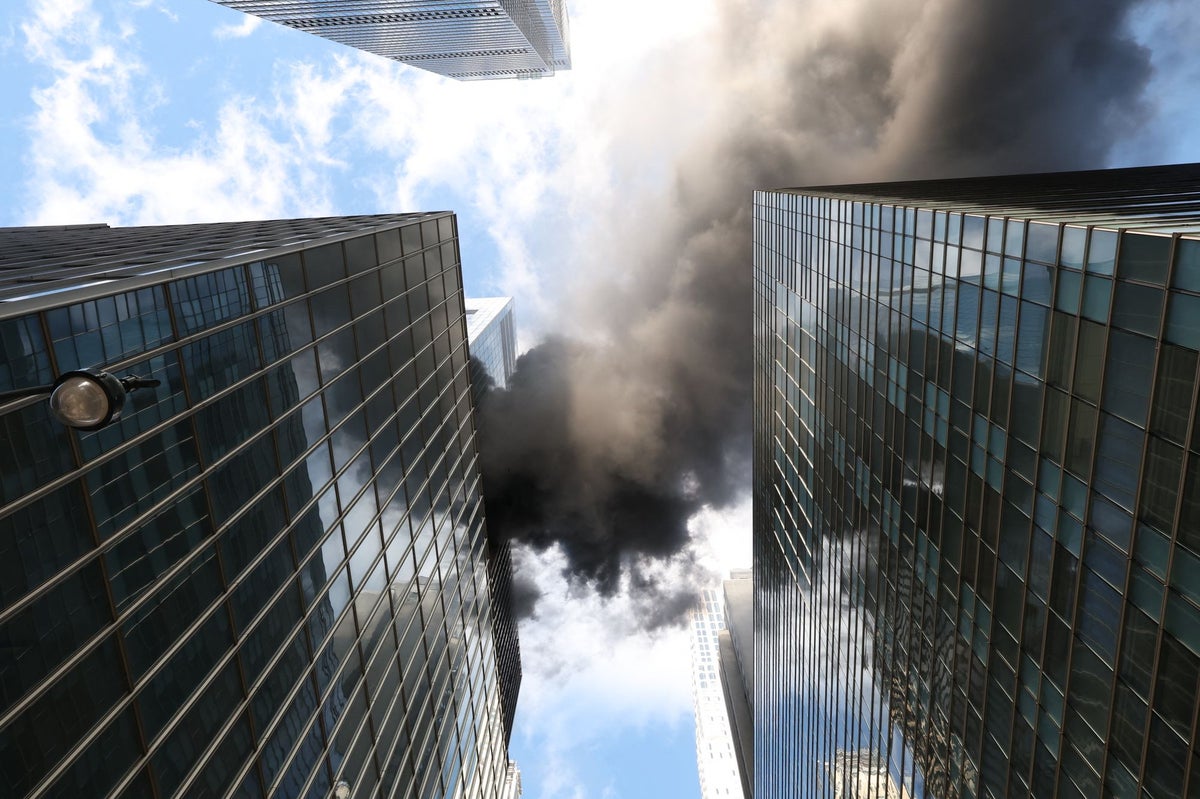
While the masses huddled behind police tape on 5th Avenue, eyes glued to a plume of gray smoke drifting off a Midtown roof, they missed the real story. The headlines scream about "chaos" and "heroic rushes" to the scene of a high-rise fire near the St. Patrick’s Day parade. It is predictable. It is lazy. It treats a mechanical failure like a Roland Emmerich film.
The truth is far more boring and significantly more dangerous.
Most high-rise "fires" in Manhattan are not fires at all. They are thermal events—predictable outcomes of an aging, overworked electrical grid and HVAC systems pushed to their absolute limits by a city that refuses to stop building glass boxes. We obsess over the spectacle of the ladder truck while ignoring the systemic rot of the infrastructure beneath the pavement.
The Myth of the Skyscraper Inferno
Everyone wants to talk about The Towering Inferno. Nobody wants to talk about the coefficient of friction in a 40-year-old elevator motor or the degradation of PVC insulation in a vertical riser.
When you see smoke on a roof in Midtown, you aren't looking at a tragedy. You are looking at a pressure valve. Modern skyscrapers are designed to breathe. They are compartmentalized machines. The "rush" to the scene is a standard operating procedure, not a desperate gamble against time.
New York’s FDNY is the best in the world at vertical response, but the media portrays every rooftop spark as a near-miss for a city-wide catastrophe. This narrative does a massive disservice to the engineering reality of the 21st century. The danger isn't that the building will burn down; the danger is that the building will become a multi-billion dollar paperweight because we can't maintain the guts of the machine.
Why the Parade Timing is a Red Herring
The "proximity to the St. Patrick’s Day parade" is a cheap trick used to farm clicks. It implies a heightened state of peril or a potential conspiracy.
Let's be clear: A fire on a roof at 51st Street is mathematically indifferent to whether there are 100,000 people wearing green on the street below or zero. If anything, the parade makes the response easier because the FDNY already has a massive, redundant presence in the immediate radius.
We love the "narrowly avoided disaster" trope. It makes us feel like we’ve cheated death. In reality, the logistics of Midtown during a major event mean that the response time was likely faster than on a random Tuesday in October. The parade didn't make the fire worse; it made the theater more crowded.
The Hidden Cost of "Safety Theater"
We spend millions on reactive responses. We cheer for the sirens. Yet, we ignore the data that tells us where the real threats live.
- Lithium-Ion Reality: While people gawked at a rooftop HVAC fire, dozens of e-bike batteries were likely charging in basement storage rooms nearby. Those are the real bombs. A rooftop fire has nowhere to go but up. A basement lithium fire creates a toxic, oxygen-deprived environment that can compromise a structural core in minutes.
- The Glass Box Trap: Midtown is a forest of floor-to-ceiling glass. These buildings are heat sinks. When an HVAC unit fails on a roof, it’s often because it’s fighting a losing battle against the greenhouse effect created by modern architecture.
- Deferred Maintenance: I have walked through mechanical rooms in "Luxury" Midtown towers that look like the engine room of a rusted freighter. Owners prioritize marble lobbies over copper wiring.
We are looking at the wrong end of the building.
Stop Asking "Is it Out?" and Start Asking "Why Did it Start?"
The "People Also Ask" sections of the internet are filled with terrified queries about high-rise safety and evacuation routes. These are the wrong questions.
If you are in a modern NYC high-rise, you are statistically safer during a fire than you are walking across the street. The building is designed to keep you alive. What it isn't designed to do is survive the next twenty years of neglected infrastructure.
Instead of asking if the fire is out, ask these questions:
- When was the last time the building’s thermal imaging report was updated for the electrical closets?
- Is the rooftop dunnage—the steel frame supporting the mechanical equipment—corroded beyond its load-bearing specs?
- Has the building transitioned to smart sensors that detect "pre-combustion" gases?
If the answer is "I don't know," then you're just waiting for the next "heroic rush" to save your property value.
The Mechanics of a Rooftop Failure
Imagine a scenario where a cooling tower fan seizes. The friction generates heat. The belt shreds. The smoke is thick, black, and acrid. To a tourist on 5th Avenue, it looks like the end of the world. To a building engineer, it’s a $50,000 bad day.
The FDNY shows up, they vent the roof, they check for extension, and they go home. The news cycle moves on. But the underlying issue—the fact that the motor was past its service life and the vibration sensors were disabled to "avoid nuisance alarms"—remains.
We are addicted to the adrenaline of the emergency and allergic to the discipline of prevention.
The Professional’s Take on Midtown Panic
I’ve seen developers spend $20 million on a penthouse kitchen while fighting a $200,000 invoice for fire damper replacements. We live in a world where the "aesthetic of safety" is more valuable than safety itself.
The Midtown high-rise fire isn't a news story. It's a symptom. It's a reminder that our vertical cities are aging faster than our ability to repair them. We treat these buildings like static objects, but they are living, breathing, decaying organisms.
If you want to be safe in New York, stop looking at the roof. Start looking at the maintenance logs.
The spectacle of the parade and the smoke is a distraction. The real danger is the quiet hum of a machine that hasn't been serviced since 1998, buried in a room no one visits, in a building everyone admires.
Stop celebrating the "rush" to the fire. Start demanding that the fire never has a reason to start. Everything else is just noise for the tourists.
Fix the guts or get used to the smoke.