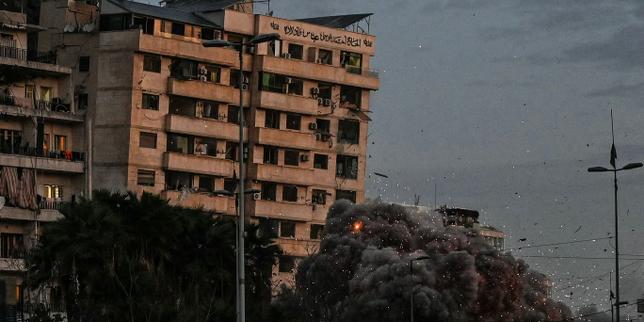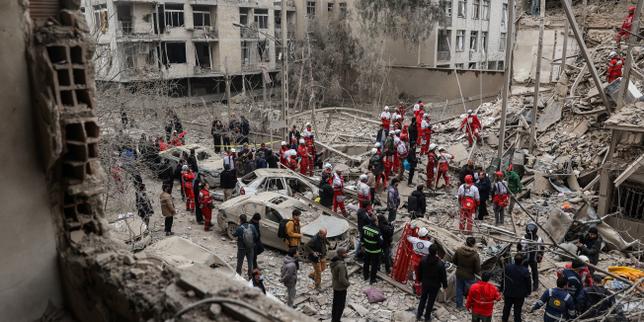
The intelligence assessments reaching the cabinet in Jerusalem have shifted from a strategy of containment to one of managed disintegration. While the world watches for the next exchange of ballistic missiles or drone swarms, the real Israeli gamble is far more radical. Israel is no longer just trying to delay the Iranian nuclear clock. It is actively leaning into the possibility of a total systemic collapse within the Islamic Republic.
This isn't just about blowing up enrichment centrifuges. It is a calculated wager that the internal structural rot of the Iranian regime is now so advanced that external pressure can push it over the edge into state failure. For decades, the mantra of Western diplomacy was that a "collapsed Iran" would be a disaster for regional stability. Jerusalem is now signaling that it views a failed state in Tehran as a preferable alternative to a functional, nuclear-armed one.
The doctrine of the head of the octopus
The strategy rests on the belief that the "Axis of Resistance" cannot survive without its central nervous system. For years, Israel fought the "tentacles"—Hezbollah in Lebanon, Hamas in Gaza, and militias in Iraq. The current shift focuses entirely on the "head." By targeting the Iranian economy and its internal security apparatus, Israel aims to break the financial and logistical backbone of these proxies.
If the center fails to hold, the periphery withers. This is the logic driving the recent escalation in direct strikes. The goal is to strip away the regime’s aura of invincibility. When a government’s primary claim to legitimacy is its ability to project power abroad while maintaining an iron grip at home, any public failure in either arena acts as an accelerant for domestic dissent. Israel is betting that the Iranian public, exhausted by hyperinflation and social repression, is waiting for a clear sign that the IRGC is a paper tiger.
Economics as a kinetic weapon
The Iranian rial has become a primary battlefield. When Israel targets energy infrastructure or shipping interests, it isn't just seeking a tactical military advantage. It is looking to trigger a currency death spiral.
The Iranian middle class has been hollowed out. What remains is a narrow elite tied to the IRGC and a massive, impoverished underclass. By tightening the economic vise, Israel forces the regime into an impossible choice. Does Tehran spend its dwindling hard currency reserves on Lebanese missiles, or on subsidizing the price of bread in Mashhad? In every scenario where the regime chooses the former, the risk of a "bread riot" turning into a full-scale revolution increases.
Jerusalem’s analysts aren't naive. They know that a revolution is unpredictable. However, they have calculated that the cost of inaction is now higher than the risk of chaos. A failed state in Iran would likely trigger a multi-sided civil war, drawing the IRGC away from the Israeli border to defend its own headquarters. From the perspective of Israeli military planners, an Iran fighting itself is an Iran that cannot build a nuclear bomb or coordinate a regional war.
The myth of the unified opposition
One of the greatest dangers in this strategy is the vacuum that follows collapse. There is no "government-in-waiting" for Iran. The diaspora is fractured, and the domestic opposition is decentralized. Israel is banking on this fragmentation. A broken, balkanized Iran—split along ethnic lines between Persians, Azeris, Kurds, and Baluchis—is a country that ceases to be a monolithic threat.
This is a cold-blooded assessment. It acknowledges that the humanitarian cost would be staggering. Millions of refugees would likely flood neighboring countries. Yet, the Israeli security establishment has grown cynical about the prospects of a "velvet revolution." They are preparing for a "Syria-style" disintegration on a much larger scale.
The intelligence blind spot
Every gamble has a flaw. The Israeli assumption relies on the idea that the IRGC will crumble under pressure rather than doubling down on a "Fortress Iran" mentality. There is a historical precedent for regimes becoming more dangerous as they face extinction. If the leadership in Tehran perceives that the end is near, their incentive to actually use a nuclear weapon—or trigger a regional apocalypse—spikes.
There is also the question of the "Day After." If Iran collapses into a mosaic of warlords and radical factions, Israel could find itself facing a threat that is harder to deter because it has no return address. You cannot sign a ceasefire with a ghost. You cannot use traditional diplomacy against a dozen different militias competing for the ruins of Tehran.
The American rift
This strategy has created a profound, if quiet, rift with Washington. The United States still clings to the hope of a managed transition or a diplomatic "freeze." The American intelligence community fears that a failed Iranian state would empower Russia and China, who would likely move in to secure the remains.
Israel is increasingly willing to ignore these concerns. The perception in the Kirya—Israel’s Pentagon—is that the U.S. is too focused on global stability to address the specific, existential threat posed by Tehran. By taking actions that increase the risk of Iranian state collapse, Israel is effectively forcing America’s hand. It is a policy of fait accompli.
Infrastructure of the end-game
We are seeing the physical preparation for this shift. Israeli cyberattacks are no longer just about gathering information; they are about disrupting the basic functions of the Iranian state. From gas station payment systems to the country’s steel industry, the targets are chosen to create a sense of pervasive administrative incompetence.
The message to the Iranian citizen is simple: Your government cannot protect you, and it cannot provide for you.
The message to the Iranian leadership is equally clear: Your grip is slipping.
The point of no return
The window for a "moderate" outcome in Iran has likely closed. Years of sanctions, failed protests, and hardline retrenchment have left the country in a state of brittle tension. Israel’s current posture is designed to snap that tension.
The risk is total. If the gamble pays off, the most significant threat to Israel’s existence since 1948 is neutralized by its own internal weight. If it fails, Israel may find itself the primary target of a dying regime’s final, desperate lunge.
The decision has been made. The provocations will continue. The economic pressure will mount. Israel has moved past the era of shadow wars and into the era of state-breaking. Whether the region can survive the resulting explosion remains an open question that Jerusalem seems willing to answer the hard way.
Ask yourself what happens to the global energy market when the world’s seventeenth-largest country stops functioning entirely.