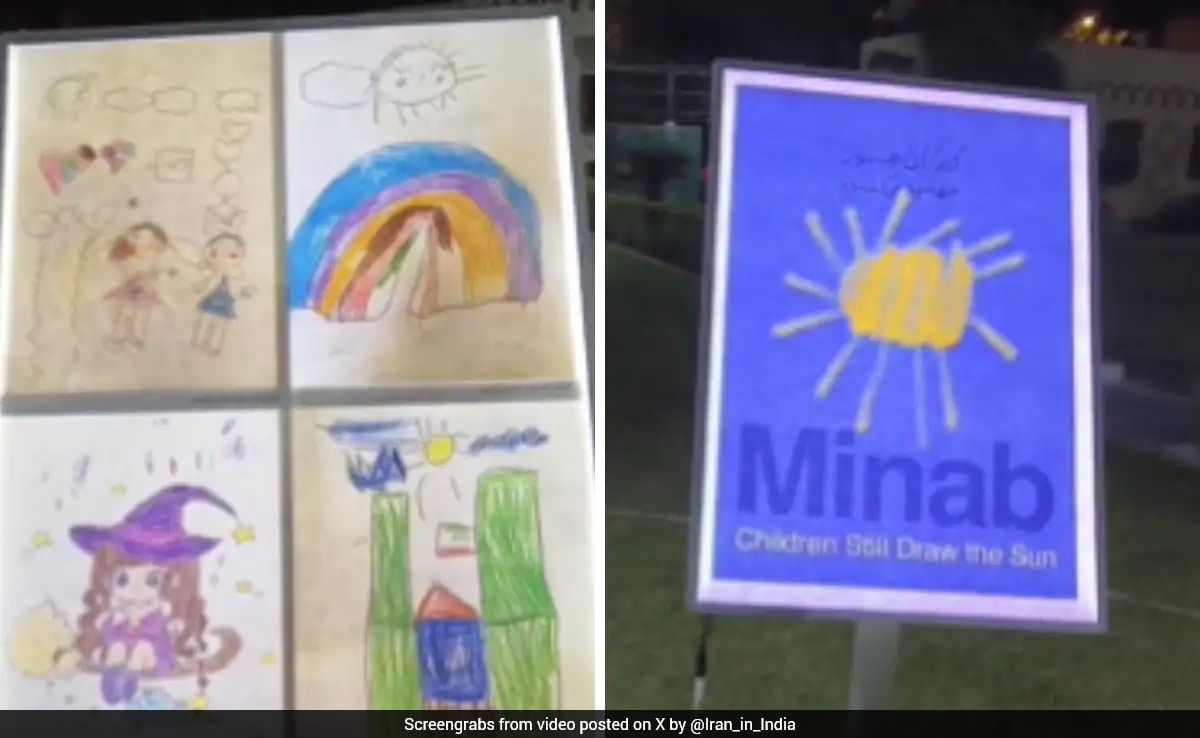
The Iranian Embassy in New Delhi recently transformed its halls into a gallery for a collection of drawings sent from a school in Minab, a coastal city in southern Iran. On the surface, this looks like a standard cultural exchange, the kind of low-stakes diplomacy that fills out the social calendars of the capital’s elite. But looking closer at the timing and the specific origin of these works reveals a more deliberate strategy to project soft power through the eyes of the next generation. These drawings are not just art. They are a curated window into a specific Iranian identity that Tehran is eager to export to the Indian public.
By showcasing the creative output of students from a relatively remote region like Minab, the embassy bypassed the usual high-brow displays of Persian carpets and ancient calligraphy. Instead, they opted for something visceral and human. This is about establishing a shared emotional ground between two nations that have historically relied on oil and infrastructure as the primary pillars of their relationship. For another perspective, see: this related article.
The Strategy of the Unfiltered Image
Diplomacy is usually a game of polished mirrors. Government officials meet in sterile rooms, exchange pleasantries, and sign memorandums of understanding that rarely impact the average citizen. The Minab collection changes that dynamic. By bringing the perspectives of Iranian children into the Indian capital, the embassy is humanizing a nation that is frequently viewed through the narrow lens of geopolitical tension and sanctions.
Minab itself is an interesting choice for this project. Located in the Hormozgan Province, it is a city defined by its proximity to the Strait of Hormuz. It is a place of transit, trade, and traditional markets. The drawings reflect this unique coastal reality, moving away from the urban sophistication of Tehran to show a side of Iran that feels familiar to many in India—vibrant, rural, and deeply rooted in local tradition. This choice creates an immediate sense of kinship. An Indian viewer in Delhi sees a drawing of a bustling Minab market and recognizes the same energy found in their own neighborhood bazaars. Similar analysis regarding this has been provided by BBC News.
Why Cultural Artifacts Outperform Political Rhetoric
Words are cheap in international relations. Promises of cooperation often stall at the border or get tangled in the bureaucracy of international banking. Art, however, travels light. It carries no legal weight, yet it possesses a heavy emotional influence. This exhibition serves as a reminder that behind the headlines of uranium enrichment and regional power plays, there is a civilian population with a rich, relatable internal life.
The embassy is tapping into a long-standing historical connection. India and Iran share linguistic roots and a history of trade that stretches back millennia. However, in the modern era, that connection has been strained by global alignments. By focusing on school drawings, Iran is essentially hitting the reset button on public perception. It is harder to maintain a cold, analytical distance from a country when you are looking at a ten-year-old’s rendition of their home life.
The Mechanics of Soft Power
Soft power works best when it doesn't look like power at all. If the Iranian government issued a press release about the beauty of their southern provinces, it would be dismissed as propaganda. When they frame it as an art show for children, it becomes a community event. The "why" here is simple: Iran needs friends. As global pressures fluctuate, maintaining a positive image in the minds of the Indian public provides a buffer. It builds a foundation of goodwill that can be called upon when political winds shift.
This isn't just about the art; it's about the invitation. By hosting these events, the embassy becomes a hub for Indian artists, students, and cultural critics. These interactions create a network of influence that is far more resilient than a trade deal. You are not just looking at a drawing; you are participating in an orchestrated act of bridge-building that uses the innocence of childhood to bypass the skepticism of adulthood.
The Local Perspective from Minab to Delhi
Minab is famous for its Thursday Market, a place where people from across the region gather to sell everything from handmade crafts to local produce. The students who created these drawings live in an environment that is a sensory overload of color and activity. Bringing those colors to Delhi is a calculated move to show that Iranian life is not monolithic.
In the Indian context, this resonates because India is itself a patchwork of diverse regional identities. The Delhi audience understands the value of regional pride. They see the Minab students not as "foreigners," but as fellow inhabitants of a complex, ancient world that is trying to modernize without losing its soul. This subtle alignment of values is the most effective form of diplomacy. It doesn't require a treaty; it only requires a shared understanding of what it means to belong to a specific place.
Challenging the Predominant Narrative
The global news cycle is dominated by stories of Iranian conflict. Whether it is maritime disputes in the Persian Gulf or domestic protests, the imagery associated with Iran is often grayscale and harsh. The Minab drawings provide a necessary splash of color. They force the viewer to reconcile the "scary" Iran of the evening news with the "creative" Iran of the embassy walls.
This duality is intentional. The embassy isn't trying to erase the political reality; they are trying to provide a counter-narrative that is equally true. They are saying, "Yes, we are a nation of complex geopolitics, but we are also a nation of families, schools, and budding artists." For an Indian observer, this nuanced view is more compelling than the one-dimensional portrayal often found in Western media outlets.
The Impact on the Indian Artistic Community
This exhibition also serves as a catalyst for local Indian artists. Seeing the work of Iranian youth encourages a dialogue about the role of art in education. It raises questions about how we teach our own children to see the world. When an Indian art teacher visits this exhibition, they aren't thinking about oil prices. They are thinking about techniques, subjects, and the universal language of a pencil on paper.
This grassroots engagement is where the real work of diplomacy happens. It is in the quiet conversations between visitors, the shared admiration for a particular brushstroke, and the realization that despite the distance, the dreams of a child in Minab are not so different from those of a child in Delhi. The embassy has successfully turned a small room in the capital into a space where the borders of the map feel significantly less rigid.
The Durability of Cultural Ties
Economic ties are volatile. A change in government or a new set of sanctions can wipe out years of financial cooperation overnight. Cultural ties, however, are made of different stuff. Once a person develops an appreciation for a country's culture, that affinity remains. It becomes part of their worldview.
By investing in these small-scale, high-impact cultural events, the Iranian Embassy is playing the long game. They are cultivating a generation of Indians who will grow up with a more sophisticated understanding of Iran. This is the ultimate goal of any foreign mission: to ensure that the relationship between two peoples is not entirely dependent on the relationship between two governments.
The Reality of the Exchange
Is it all sunshine and roses? Of course not. Every cultural exhibition is a form of curation. We are seeing what the embassy wants us to see. We are seeing the hopeful, the bright, and the innocent. But even within that curation, there is a grain of essential truth. These children exist, their talent is real, and their desire to be seen by an international audience is genuine.
The success of the Minab exhibition lies in its simplicity. It didn't need a massive budget or a celebrity endorsement. It only needed a stack of drawings and a willingness to share them. In an era where communication is often high-speed and low-substance, there is something profoundly effective about slowing down to look at a child's drawing of their hometown.
The Iranian Embassy has demonstrated that the most powerful tool in a diplomat's arsenal might not be a briefcase full of documents, but a box of crayons and a blank piece of paper. They have managed to turn a school project from a remote coastal town into a significant moment of international connection. This is how you win hearts and minds in the 21st century—not by shouting louder, but by telling a better, more human story.
The drawings from Minab will eventually be packed up and sent back, but the impression they left on the Delhi art scene will remain. It is a reminder that the world is much smaller than the politicians lead us to believe, and that the distance between a school in Iran and a gallery in India can be closed with nothing more than a bit of imagination and a shared appreciation for the creative spirit.