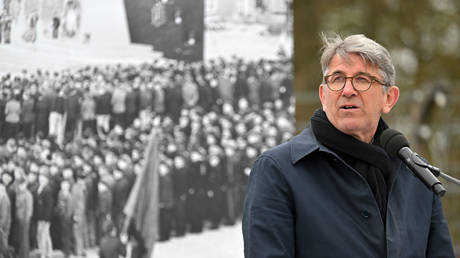
The air at the Buchenwald concentration camp memorial usually carries the weight of heavy, enforced silence. That silence shattered recently when Claudia Roth, Germany’s Federal Minister for Culture, was met with cries of "fascist" and "get out" during a ceremony marking the 79th anniversary of the camp’s liberation. For a Green Party politician whose entire career has been built on the foundations of anti-fascism and "coming to terms with the past," the irony was as sharp as a razor. This was not a fringe protest by neo-Nazis. It was an eruption of anger from activists and segments of the public who believe the German state’s current domestic and foreign policies have become the very thing they claim to guard against.
The heckling of a high-ranking official at a Holocaust memorial site marks a definitive shift in the German political climate. It signals that the post-war "culture of remembrance"—once the untouchable bedrock of German identity—is fraying under the pressure of modern geopolitical conflicts. Specifically, the government’s unwavering stance on the conflict in Gaza has created a chasm between the political elite and a vocal coalition of artists, intellectuals, and descendants of survivors.
The Memory Culture Paradox
Germany has long been praised for Vergangenheitsbewältigung, the process of struggling to overcome the horrors of its Nazi past. Claudia Roth sits at the pinnacle of this effort. Her office doles out millions in funding to museums, memorials, and art projects designed to ensure that "never again" remains a living mantra.
However, the definition of "never again" is currently being contested in the streets of Berlin and the courtyards of former death camps. To the German government, this mantra translates to an unconditional "reason of state" (Staatsräson) regarding the security of Israel. To the protesters who shouted down Roth, the mantra is universal. They see a contradiction in a government that funds Holocaust education while simultaneously cracking down on pro-Palestinian speech and cultural expression within its own borders.
This tension has turned cultural institutions into battlegrounds. From the cancellation of award ceremonies for Jewish-Palestinian authors to the dissolution of art collectives at Documenta, the state’s hand has become increasingly visible. When the state begins to define which forms of grief are acceptable and which are subversive, the "culture minister" stops being a patron and starts being a gatekeeper.
The Weaponization of Bureaucracy
The resentment directed at Roth isn't just about rhetoric; it is about the mechanics of how culture is managed in Germany. In recent months, there have been repeated attempts to introduce "anti-discrimination clauses" for cultural funding. While these sound noble on paper, critics argue they function as ideological loyalty tests.
Under these proposed rules, artists and institutions would have to adhere to specific definitions of antisemitism—specifically the IHRA definition, which includes certain types of criticism of the state of Israel—to receive public money. In a country where almost every major gallery, theater, and memorial depends on state grants, this is a powerful lever of control.
Roth has found herself in the crosshairs because she represents the institutionalization of this pressure. The activists at Buchenwald were highlighting what they perceive as a "new authoritarianism" masked by the language of historical responsibility. By labeling her a "fascist," they weren't accusing her of wearing a brown shirt; they were accusing her of using the power of the state to silence dissent and marginalize those who don't fit the official narrative of German guilt and redemption.
A Memorial Site Under Siege
Buchenwald is not just a graveyard; it is a pedagogical tool. Every year, thousands of students and international visitors walk through the gates to learn about the mechanics of dehumanization. To have a minister heckled there is seen by the establishment as a desecration.
But we must look at the demographics of the anger. The crowd at these events is no longer just the aging "68ers" who pushed Germany to face its past. It includes a younger, more diverse generation, including many from Germany's large migrant communities. For them, the German state’s historical baggage feels like a tool used to exclude them from the current political discourse. When Roth speaks of "democratic values" at a site of Nazi atrocities, but her government bans Palestinian flags in schools, the cognitive dissonance becomes a flashpoint for rage.
The security apparatus responded to the Buchenwald incident with predictable alarm. There are now calls to tighten security at memorial events and to prosecute those who "defame" the memory of the Holocaust by using such venues for political protest. This response, however, misses the fundamental issue. You cannot legislate a consensus that has already broken.
The Failure of the Middle Ground
For decades, the German political center—from the CDU on the right to the Greens on the left—maintained a unified front on memory politics. That center is collapsing. On one side, the far-right AfD wants to do away with the "cult of guilt" entirely, calling for a "180-degree turn" in how Germany views its history. On the other, a burgeoning left-wing and internationalist movement argues that the state has hijacked the memory of the Holocaust to justify modern-day militarism and civil liberty restrictions.
Claudia Roth is caught in the middle of this pincer movement. She is too "woke" for the right and too "statist" for the radical left. Her presence at Buchenwald was intended to be a symbol of continuity and moral clarity. Instead, it became a mirror reflecting a deeply divided nation.
The government's insistence that there is only one way to remember the past is proving counterproductive. When the state mandates how citizens should feel about history, it invites a backlash that targets the very institutions designed to preserve that history. The "fascist" slur, however hyperbolic, is a symptom of a public that feels the state is no longer listening, only lecturing.
The Cost of Institutional Silence
The chill currently blowing through Germany’s cultural sector is quantifiable. International artists are withdrawing from German festivals. Academics are turning down chairs at German universities, citing a climate of censorship. The "Roth incident" at Buchenwald is the loudest signal yet that the international reputation of Germany as a bastion of liberal, self-critical culture is at risk.
If the person in charge of culture becomes a figure of derision at a site of ultimate mourning, the mission of that office has failed. The German government's strategy has been to double down on existing policies, hoping that the protests will fade or that the public will be shamed into silence by the weight of history. That strategy is failing.
The protestors at the camp weren't just attacking a politician; they were attacking the idea that the state owns the moral high ground. They were pointing out that a "culture of remembrance" that cannot tolerate dissent in the present is a museum piece, not a living ethic.
History is not a static script to be read by government officials at annual ceremonies. It is a volatile, living force. When the gap between a state's historical rhetoric and its current actions becomes too wide, the memorial sites themselves become the front lines of a new kind of civil conflict. The cries at Buchenwald were not a mistake or a fluke. They were a warning that the era of managed memory is over. Germany now faces a future where its past is no longer a source of unity, but a weapon used by all sides in a battle for the soul of the republic.
The state must decide if it wants to be the protector of free expression or the curator of a sanitized, mandatory history. Until that choice is made, the silence at places like Buchenwald will continue to be broken.